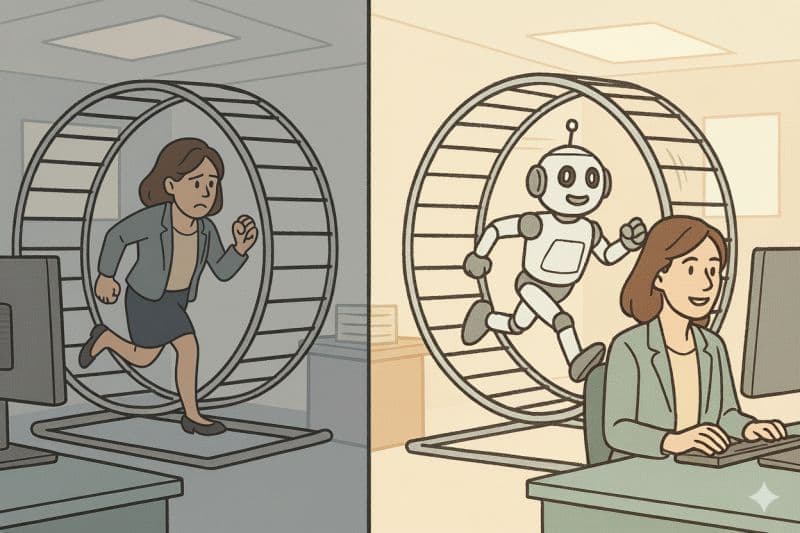
Let AI Do Your Hamster Work
"Hamster work." Always said with a sigh.
That was one of my mom's favorite phrases for repetitive, unsatisfying work that nevertheless must be done: laundry, dishes, the endless cycle of tasks that keep things running but never feel like progress. The work that keeps you busy but leaves you wondering what you actually accomplished.
No matter who you are or where you work, hamster work is part of the job. There's a reason that image of Peggy with Don Draper and the quote "That's what the money is for" became a timeless meme. We all have tasks that drain energy without creating real value.
But here's what's changed: hamster work doesn't have to be human work anymore.
The Good Work vs. The Necessary Work
I hope that in your work, you have at least some proportion of it that is the opposite of hamster work—things you do and problems you solve that keep you engaged, motivated, challenged, and wanting to do more. The work that made you choose your profession in the first place.
The goal of much of the work we do with AI isn't to replace human judgment or creativity. It's to maximize the good work and let AI handle the hamster work. To give people back the time and mental energy for the parts of their job that actually matter.
A Simple Example
A regular client recently faced a familiar burden: a marketing firm needed her to fill out an extensive questionnaire about her background, work history, client preferences, and professional philosophy. All necessary information for them to do their work, but for her, just one more bit of tedium on top of an already busy schedule. The sort of thing that's easy to defer because there's always something more urgent—working in the business instead of on the business.
When we talked about it, she made an offhand comment that proved insightful: "All of this information is already out there—my LinkedIn, my website bio, things I've written." That observation opened up a straightforward solution.
We gathered the relevant documents and created a ChatGPT project as a knowledge base. The only technical step was using Chrome's developer console to scrape the questionnaire from the website, which wanted users to go through it one question at a time. We extracted all the questions, formatted them in a markup file, and fed that to ChatGPT with simple instructions: populate the questions, indicate confidence levels for factual responses, and answer open-ended questions in her voice.
Within minutes, we had a comprehensive and accurate draft. She reviewed it, made a few minor edits, and filled out the form. What could have taken hours of frustrating work was reduced to a quick review. Better still, the ChatGPT project now serves as a biographical asset library—future questionnaires will be even easier.
Beyond the Immediate Solution
This simple project revealed something larger. The same structure could be valuable for job seekers—people who face endless application forms, recruiter questionnaires, and systems like Workday that ask the same information in slightly different ways.
The hamster work of job searching is particularly soul-crushing because it's high-stakes hamster work. Every application feels important, yet the repetition is exhausting. Having AI handle the rote parts while you focus on customization and genuine engagement could make a meaningful difference.
The Broader Pattern
What makes this approach work isn't sophisticated technology or complex automation. It's recognizing where human effort adds value and where it doesn't.
Humans should spend their time on:
- Making strategic decisions
- Building relationships
- Applying judgment and creativity
- Doing work that energizes them
AI can handle:
- Reorganizing existing information
- Drafting routine content
- Formatting and data entry
- Repetitive tasks with clear patterns
The division isn't about capability—it's about energy and engagement. Even simple hamster work consumes mental bandwidth. Every small task requires a decision, a context switch, a bit of attention. Individually minor, collectively exhausting.
Making It Practical
The most effective AI implementations we've seen aren't the flashiest or most technically impressive. They're the ones that solve specific, real annoyances. They take something that was draining time and attention and make it trivial.
You don't need complex systems or expensive tools. You need to identify the hamster work in your world and ask: "Could AI do this instead?"
Sometimes the answer is a simple ChatGPT project. Sometimes it's a workflow automation. Sometimes it's a custom tool. But it always starts with recognizing that your time and attention have value, and not everything that demands them deserves them.
If you're spending too much time on hamster work and want to explore practical ways AI could help, reach out. We specialize in identifying these opportunities and implementing solutions that actually stick.